
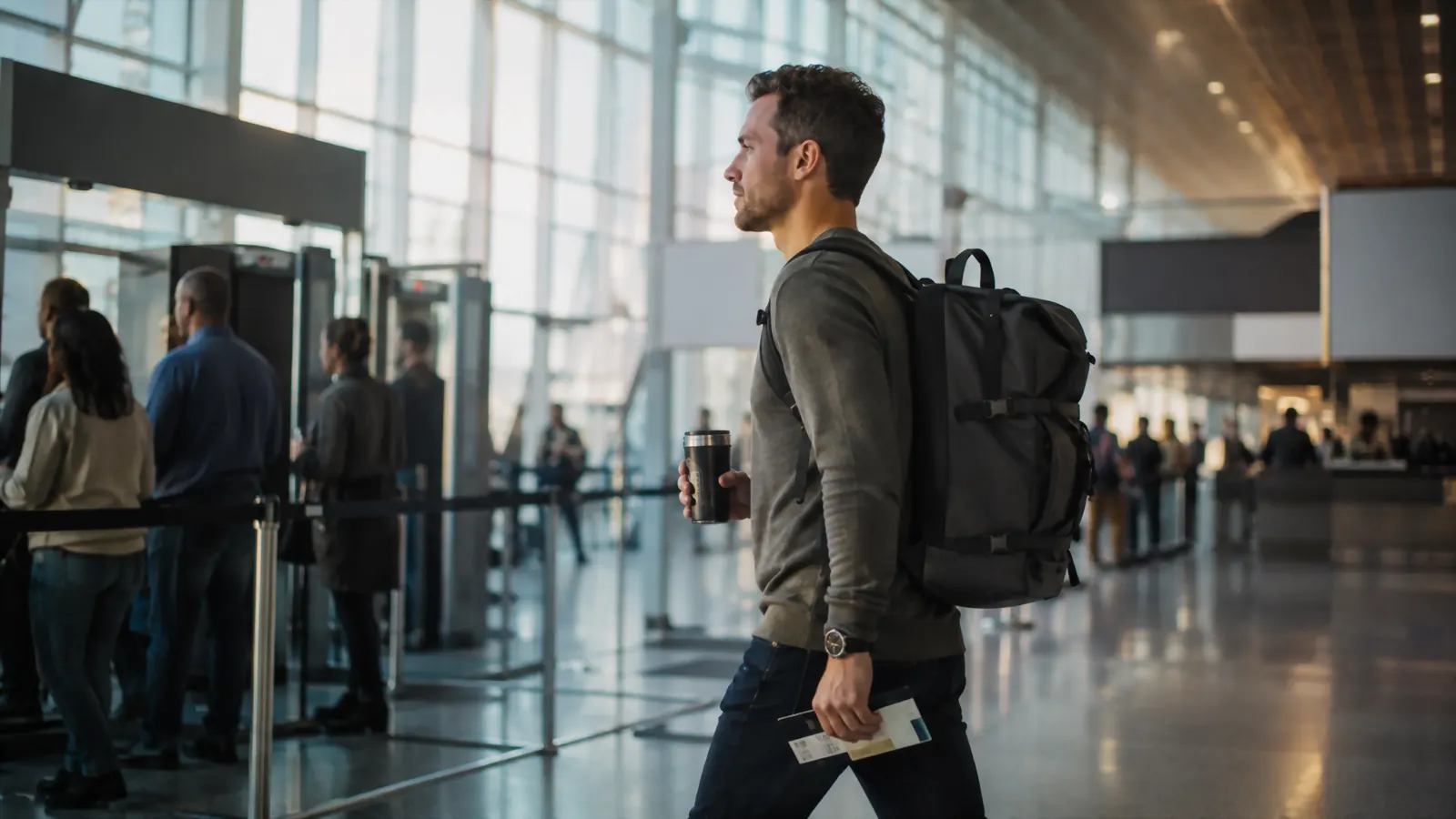
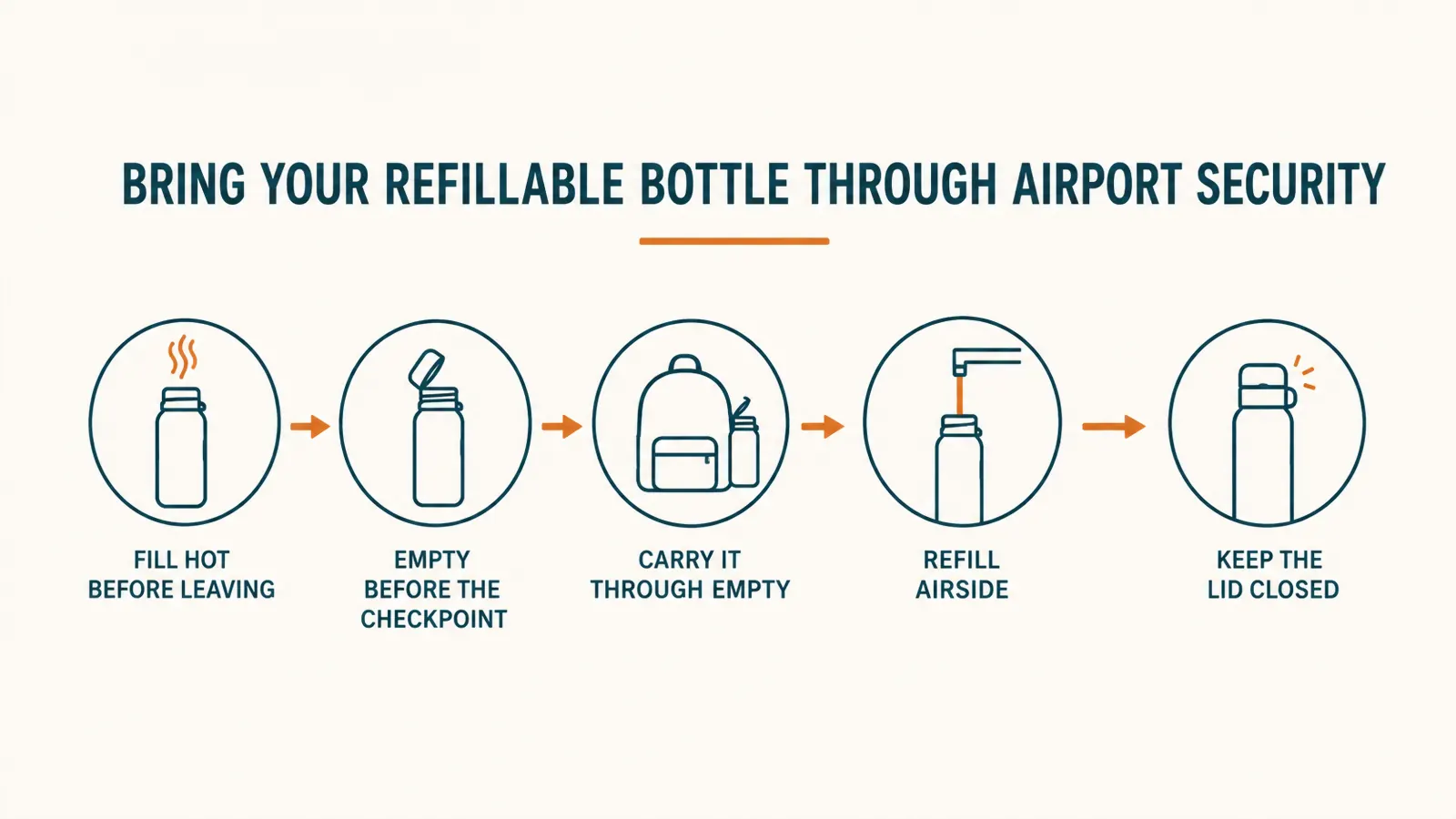
The first time I tried to bring a full cup of coffee through airport security, an officer waved me toward a trash can and I had to pour out coffee I'd just paid for, three feet from the checkpoint, while the line behind me watched. That's the mistake almost everyone makes once. You cannot carry a full cup of hot coffee through a security checkpoint. Liquids over the allowance don't go through screening, full stop, and no tumbler, insulated or not, changes that rule. What actually works is a sequence, not a product: fill it hot before you leave, empty it before the checkpoint, and refill it once you're airside. The tumbler's job isn't to sneak coffee past security. Its job is to hold the heat on both ends of that sequence, before the line and after it.
I'm away from home most weeks, and this is the process I've settled into after getting it wrong more than once. It's built around a stainless steel, insulated tumbler, an Owala SmoothSip in my case, twelve ounces, with a slider lid I can push open one-handed. That size and that lid matter for a specific reason once you see how the whole sequence actually plays out at a real checkpoint on a real travel morning, not in theory.
None of this is complicated once you've done it a handful of times, but almost nobody explains it as a sequence. Most advice online either tells you to just buy coffee airside and skip the whole problem, which ignores the mornings when you actually want your own coffee before you've even left the house, or it vaguely implies you can somehow carry a full cup through if the lid is tight enough, which is not true and will cost you the coffee at the belt. Treating it as five deliberate steps, rather than one vague habit, is what finally made my travel mornings predictable instead of a coin flip.
The tumbler that actually earns its keep on both sides of security
See today's price on the Owala SmoothSip, the insulated tumbler that holds the heat before the checkpoint and after it.
Amazon Check Today's Price on Amazon →Step 1: Fill It Hot Before You Head to the Checkpoint
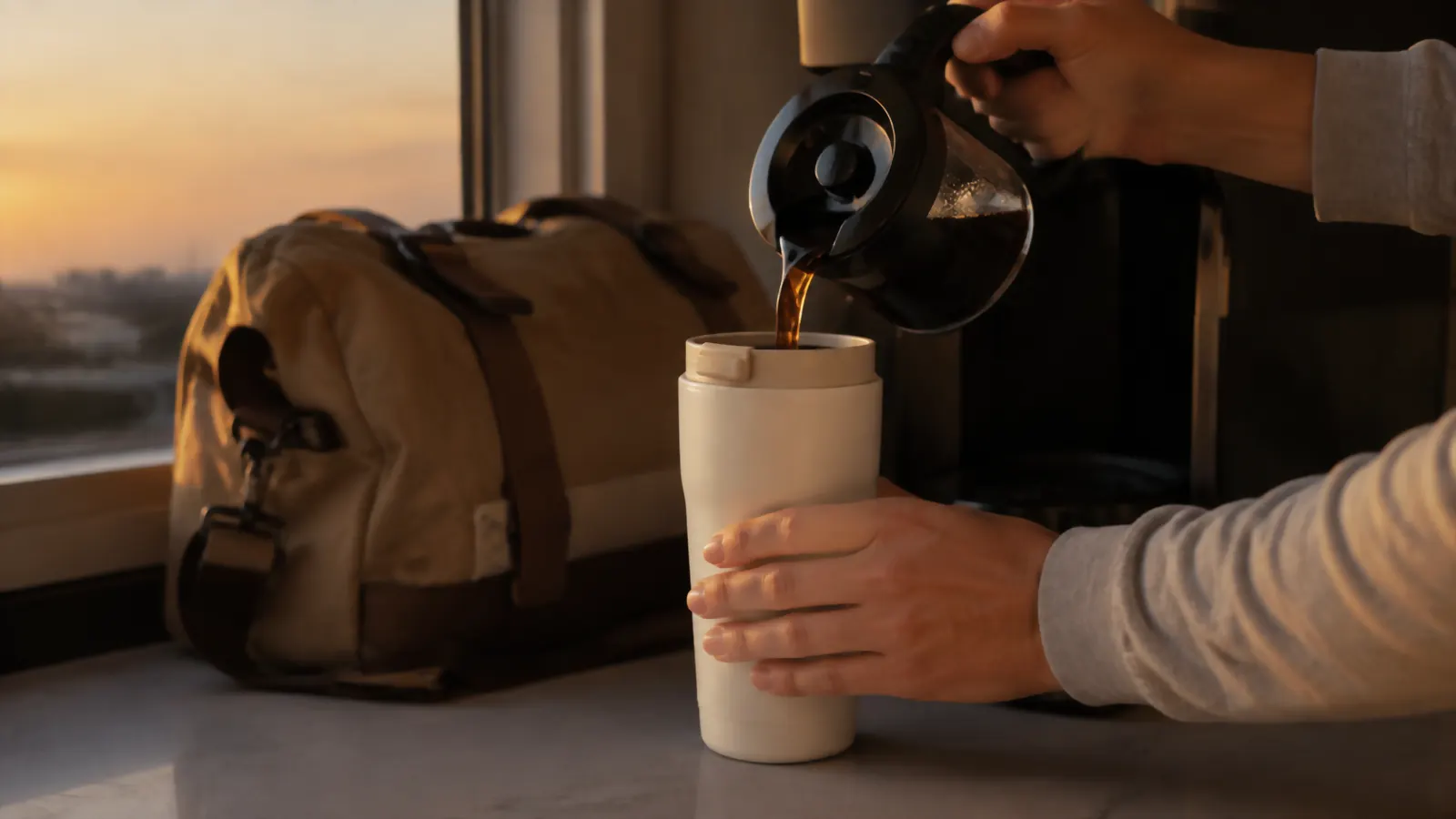
Whatever hot coffee you're going to drink before the flight, pour it into your insulated tumbler at the source, meaning your kitchen, a hotel room coffee maker, or a coffee shop counter well before you're standing in a security line. This sounds obvious, but the habit that ruins mornings is grabbing a paper cup on the way out the door and only thinking about the tumbler once you're already at the airport. Fill it early, and it has already started doing its job by the time you're walking toward the terminal.
I fill mine at whatever coffee maker is closest, hotel room or home, because a stainless insulated tumbler holds heat noticeably better across a walk and a wait than a paper cup ever does. The Owala SmoothSip is built for both hot coffee and iced coffee, so I don't have to think about which drink it's rated for depending on the season. I just pour what I'm actually drinking that morning and move on.
This step is also where the slider lid earns its place. I can push it shut immediately after pouring and carry the tumbler through a parking garage, a rideshare pickup, and a terminal entrance without worrying about it sloshing or spilling against a bag strap the way an open-topped paper cup does.
If I know I'll be cutting it close on time, I fill the tumbler only about two-thirds full rather than to the brim. A tumbler that's easier to drink down quickly in a queue is more useful than one that's technically fuller but takes longer to finish before you reach the belt.
Step 2: Know What Happens to Liquids at the Checkpoint
This is the step people skip, and it's the one that actually determines whether your morning goes smoothly or ends with your coffee in a trash can. Liquids past a certain amount are not permitted through a standard security checkpoint, and that rule applies to a full tumbler of hot coffee exactly the same way it applies to a bottle of water. Airport security rules also vary somewhat by country and can change, so I don't rely on memory. I check the current rules for whichever airport I'm flying out of before I leave, rather than assuming the last airport's rules still apply.
Once you accept that a full tumbler of coffee is not getting through a checkpoint, the whole plan gets simpler. You stop trying to find a workaround and start planning around the actual rule, which is what separates a smooth morning from a stressful one at the belt. I've watched other travelers argue with an officer about a nearly full cup, and it never ends with them keeping the coffee. It just ends with a delay for everyone behind them, including me.
This is also why I don't bother trying to guess an exact allowance number and repeat it here as if it's fixed. Airports and agencies update these rules, and the specific figure matters far less than the habit of checking before you travel and planning around whatever the current rule actually is for your route.
Step 3: Empty the Tumbler Before You Reach the X-Ray Belt
Drink it down or pour it out before you're standing in the screening line, not after an officer stops you. I try to time my pour in step one so that I've finished most of the coffee by the time I'm approaching the checkpoint, which means there's little left to deal with. On the mornings where there's still coffee left, I drink the rest standing in the queue rather than holding onto it and hoping nobody notices, because they will notice, and it costs you more time than just finishing the cup.
If you genuinely can't finish it in time, pour it out at a trash can before the belt rather than at the belt itself. Either way, the tumbler should be empty by the time it's your turn to place things in a tray. This is the step that actually prevents the scene I described at the start, and it's the one nobody tells you about until it happens to them.
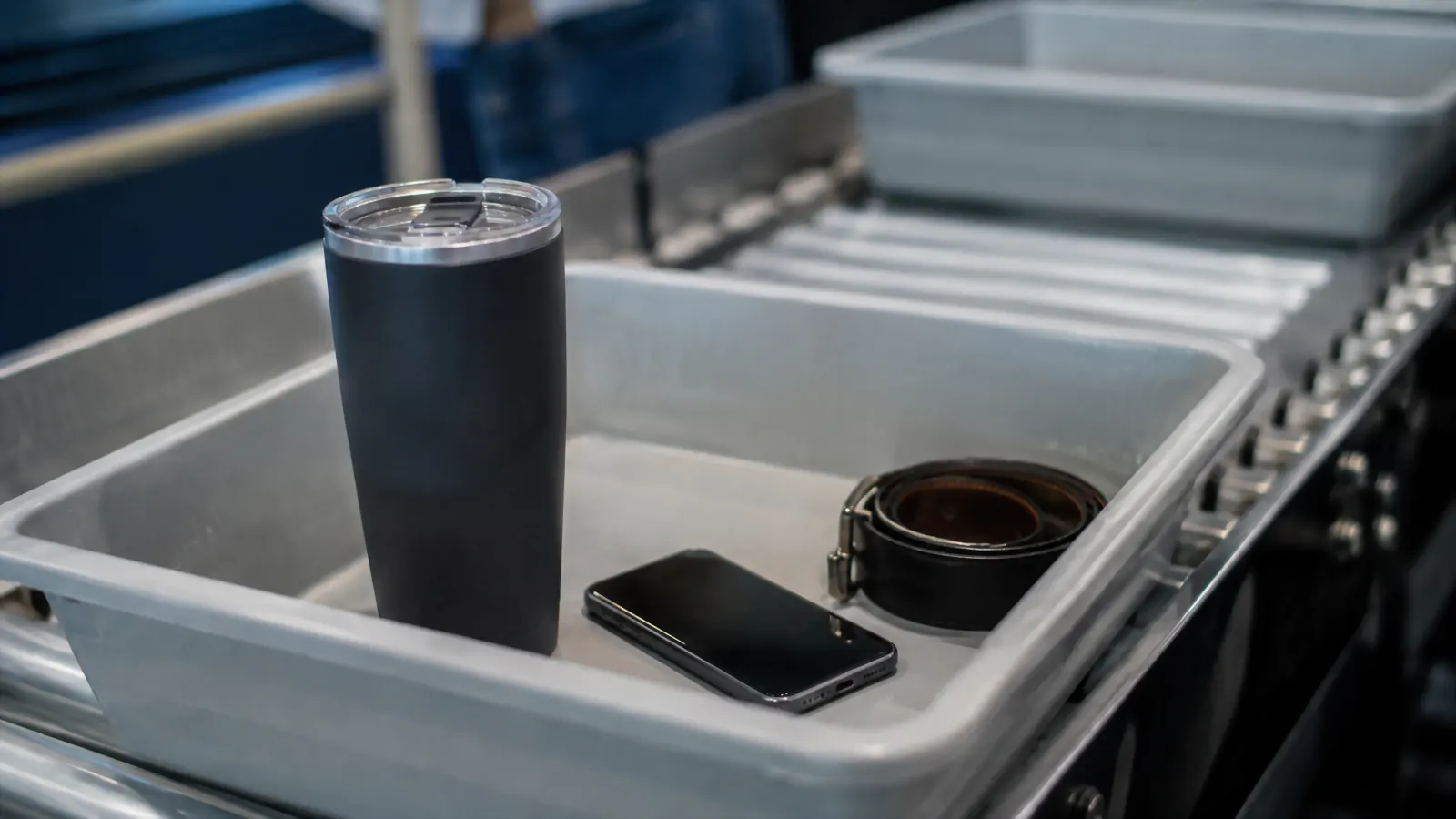
Once it's empty, the tumbler itself isn't a liquid and doesn't need special handling beyond whatever your airport asks for electronics and other carried items. I put mine in the tray with the lid slid shut so nothing rattles loose, and it goes through screening like any other empty container. I've never had an officer ask me to explain an empty tumbler, and that's exactly the point of doing it this way instead of trying to argue for an exception.
Step 4: Refill on the Far Side of Security
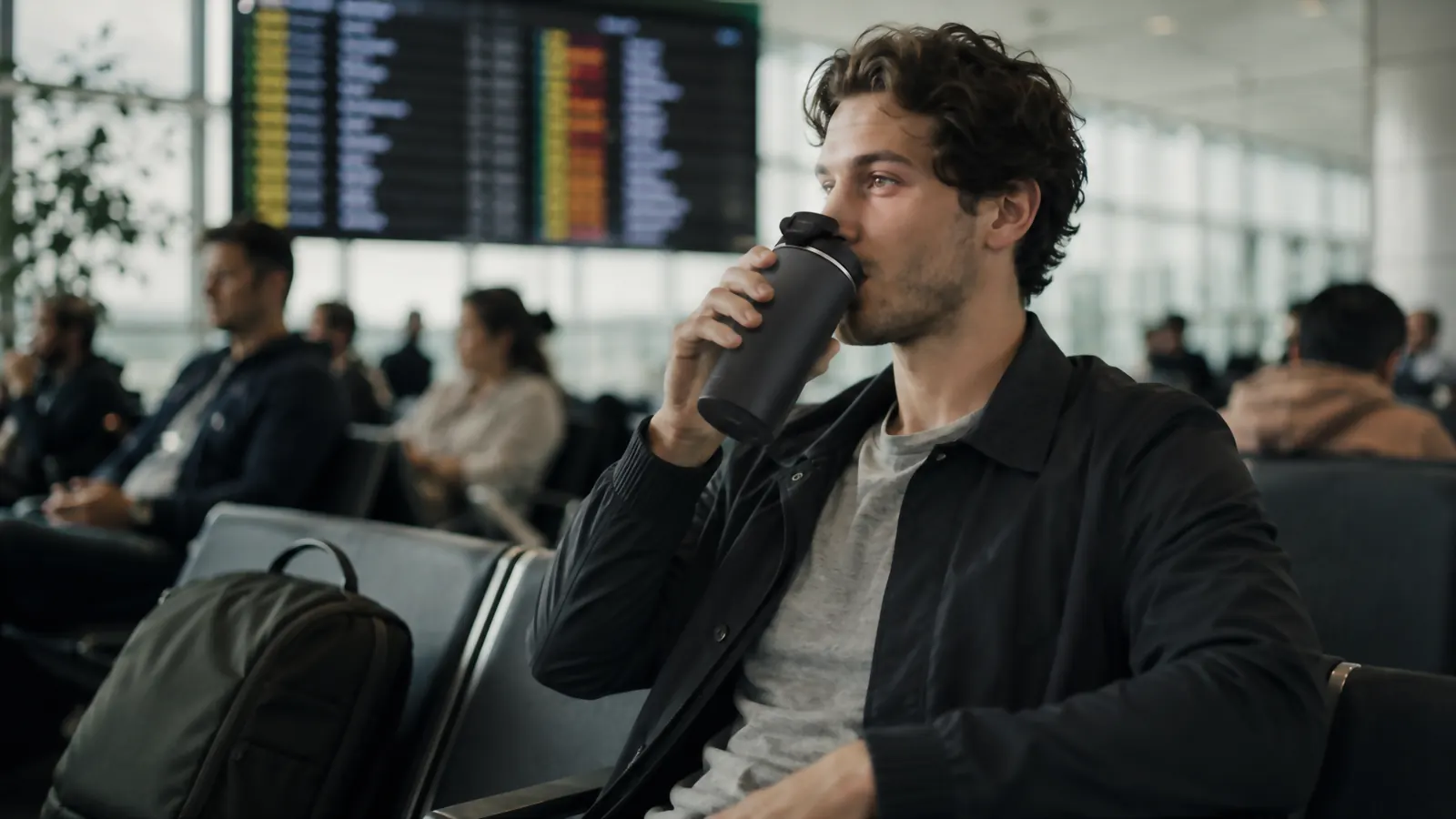
This is the step that makes the whole plan worth the trouble. Once you're airside, most terminals have at least one coffee stand, and this is where the empty tumbler in your bag actually pays off. Instead of buying coffee in a flimsy paper cup that will be lukewarm before boarding, hand your own tumbler across the counter or fill it yourself if the stand allows it, and you're carrying hot coffee in something built to hold onto that heat for the rest of your walk to the gate.
I've done this enough times now that it barely registers as a decision anymore. Empty tumbler out of the bag pocket, refill at whatever stand is on the way to my gate, lid slid shut, and I'm holding hot coffee again within a few minutes of clearing the checkpoint. The alternative, buying a paper cup and hoping it survives until boarding, has never once worked out as well.
If your gate is a long walk from the nearest coffee stand, factor that into your arrival time rather than rushing the refill. A rushed pour is how you end up with coffee down your hand instead of in the tumbler, and it defeats the entire point of the process.
On connecting flights, I've started treating the refill as something that can happen more than once. If I land with an empty or nearly empty tumbler and there's a coffee stand near my next gate, I refill again rather than waiting until I'm home. The tumbler being reusable and easy to rinse in an airport bathroom sink makes this a realistic habit rather than a one-time trick for the first leg of a trip.
Step 5: Keep the Lid Closed Between Sips to Hold the Heat
Once you're through security and refilled, the last habit that actually keeps coffee hot through the rest of your flight is a small one: slide the lid shut between sips instead of leaving it open in your bag or a seat pocket. An insulated tumbler does most of the work on its own, but an open lid lets heat escape the same way an uncapped thermos does, and it's an easy habit to forget when you're distracted by boarding announcements and overhead bin space.
The slider lid on the SmoothSip makes this an easy habit to build because it's a thumb push to open and the same motion to close, no unscrewing a full cap one-handed while you're also holding a boarding pass. I push it open at the gate, take a sip, slide it shut, and repeat that through boarding and the first part of the flight. By the time I'm settled into a seat, the coffee is still genuinely warm, not the room-temperature disappointment that a paper cup would have become by then.
This same close-it-between-sips habit works just as well going the other direction if you've filled it with iced coffee instead, which matters if your route swings between a cold terminal and a warm one on the same trip. Keeping the lid shut when you're not actively drinking protects the cold the same way it protects the heat.
What Else Helps
A few smaller habits make the whole sequence smoother without adding any real effort. Give yourself an extra few minutes at the airport specifically for the fill-empty-refill process, rather than treating coffee as something you'll squeeze in if there's time. Keep the tumbler in an outer bag pocket you can reach without digging, both for the pre-checkpoint pour and the post-checkpoint refill, since fumbling for it at either point slows you down and increases the odds of a spill.
And if you're someone who drinks a large coffee at home, remember that a twelve ounce tumbler is meant to get you through the checkpoint and into your first airside cup, not to replace a full thermos for an entire travel day. Treat it as the vessel for two or three shorter fills rather than one giant one, and the size stops being a limitation and starts being exactly what it's built for. I've stopped thinking of it as one cup of coffee and started thinking of it as the container that carries whatever coffee I'm drinking at that particular hour, refilled as many times as the trip requires.
It also helps to rinse the tumbler at some point during a longer travel day rather than letting a used one sit closed in your bag for hours between fills. A quick rinse at a bathroom sink after you've finished a cup keeps it ready for the next refill and keeps it from holding onto smell between coffees, which matters more on a two- or three-leg travel day than it does on a single short flight.
Keeping coffee hot through airport security was never about the tumbler beating the rules. It was about having something worth refilling once you're through them.
Stop losing your coffee to the checkpoint
See today's price on the Owala SmoothSip and build the fill, empty, refill habit into your own next trip.
Amazon Check Today's Price on Amazon →