
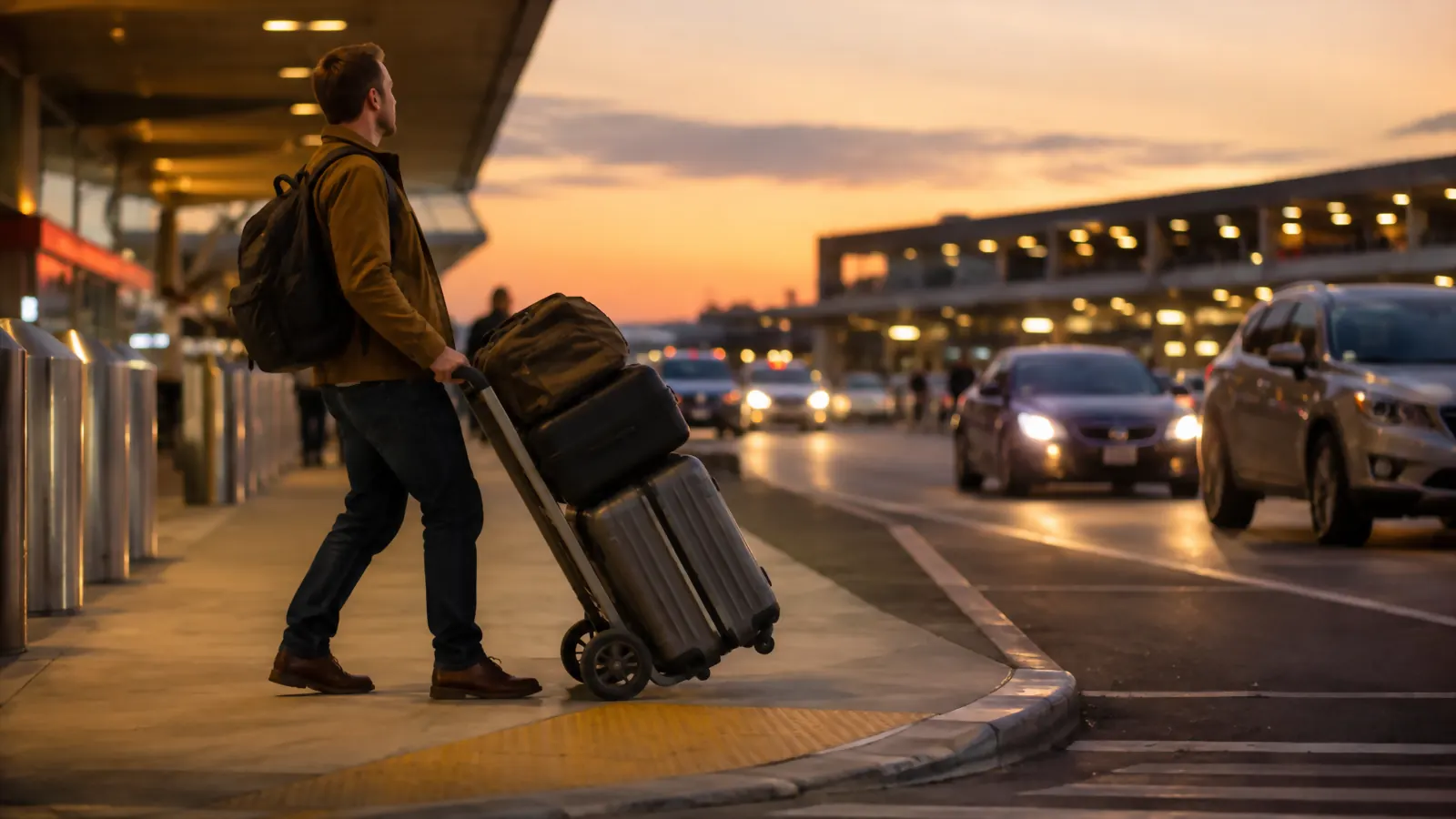
I've hauled luggage through more parking garages, hotel loading docks, and short-term airport lots than I can count. Most weeks I'm gone again before the laundry from the last trip is even folded, and after a while you stop packing for a vacation and start packing for survival: the good boots, the charger bricks, the extra bag of gear that somehow always ends up checked instead of carried on. Moving heavy luggage on your own, with no bellhop and no cart waiting curbside, is one of those problems nobody warns you about until your arm goes numb halfway across a parking structure.
The fix isn't strength, it's a folding cart used the right way. A lot of people buy one, strap a bag to it sideways, and wonder why it still feels like wrestling a fridge down a hallway. The cart isn't doing the work if you load it wrong. Below is the method I actually use to move heavy luggage with a folding cart: the load order, the strap timing, the balance check, and the route planning that keeps a loaded cart from becoming its own hazard. None of it requires strength you don't already have. It requires doing five steps in the right order, every time, not just when you remember.
It also requires picking a cart that can actually carry what you're asking it to carry. I've used cheaper carts that flexed and squeaked under two checked bags, and I've used ones that shrugged off a full stack without a second thought. Once you've felt the difference, you stop thinking of a folding cart as an accessory and start thinking of it as the thing standing between your back and a bad week.
Stop Carrying What You Could Be Rolling
The cart I reach for is the SPACEKEEPER folding hand truck. It's rated for up to 500 lb, folds flat for the trunk or closet, and holds a 4.0 rating across 9,304 reviews, which tells you it's been tested by a lot of people moving a lot of heavy luggage, not just one good weekend.
Amazon Check Today's Price on Amazon →Step 1: Match the Cart's Capacity to What You're Actually Carrying
Before loading anything, know what the cart is rated for. Airline checked-bag limits don't tell the whole story. If you're moving two checked bags plus a duffel and a laptop bag, the combined weight is well beyond what most people guess standing at the curb. The cart I use, a SPACEKEEPER folding hand truck, is rated for up to 500 lb, which covers a genuinely stacked load without me wondering if the frame is going to give out halfway across a lot.
Weigh or estimate before you stack. Two checked bags near the airline limit plus a full duffel adds up fast, and that's before a rolling laptop bag goes on top. Knowing the cart's ceiling matters more than knowing your own bag count, because the failure point isn't the tenth trip, it's the one time you guessed wrong and pushed a cart that was already maxed out.
If you regularly need to move heavy luggage for work travel, family visits, or hauling gear to a rental, buy for the heaviest day you'll ever have, not the average one. A cart with real headroom above your typical load is what lets you stop thinking about capacity at all, trip after trip, instead of doing mental math every time you pack.
A cart working near its limit tends to give you warning signs before anything actually fails. The wheels feel like they're dragging instead of rolling, the frame flexes visibly when you push, or the whole thing wants to fold itself flat under the load. None of that means the cart is broken, it usually means you're closer to the ceiling than you should be for a comfortable push, and it's worth splitting the load or trimming what you're carrying rather than powering through.
Step 2: Stack the Heaviest Bag First, Low and Centered
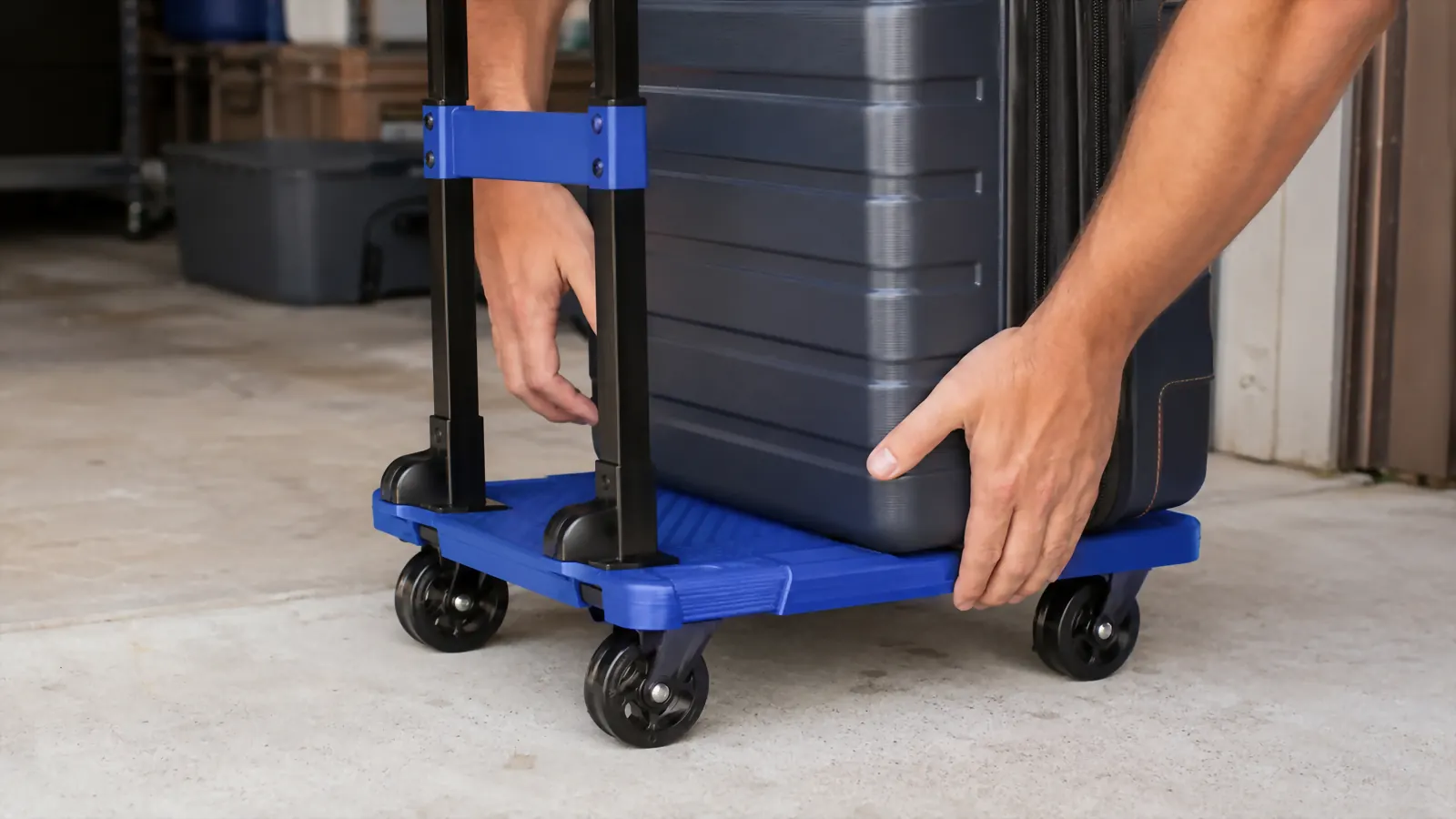
The order you stack in decides whether the cart rolls straight or fights you at every curb. The heaviest bag goes on the base plate first, pushed flat against the frame, not perched on a corner. That's your foundation, and everything else depends on it being right.
Everything after that gets lighter as you go up. A rolling suitcase against the frame, a duffel laid across the top, a laptop bag wedged into whatever gap is left. Keep the stack centered over the wheelbase rather than leaning forward or back, because a top-heavy stack wants to tip the second you hit an incline or a rough patch of pavement.
Resist the urge to load your heaviest bag last just because it's the one you grabbed off the belt first. Unpack the stack, reorder it, and put the heavy bag on the bottom even if that means restacking right there at the curb. It takes thirty seconds and it's the difference between a cart that rolls and one that tips the first time you turn a corner.
Step 3: Strap the Load Before You Tilt the Cart Back
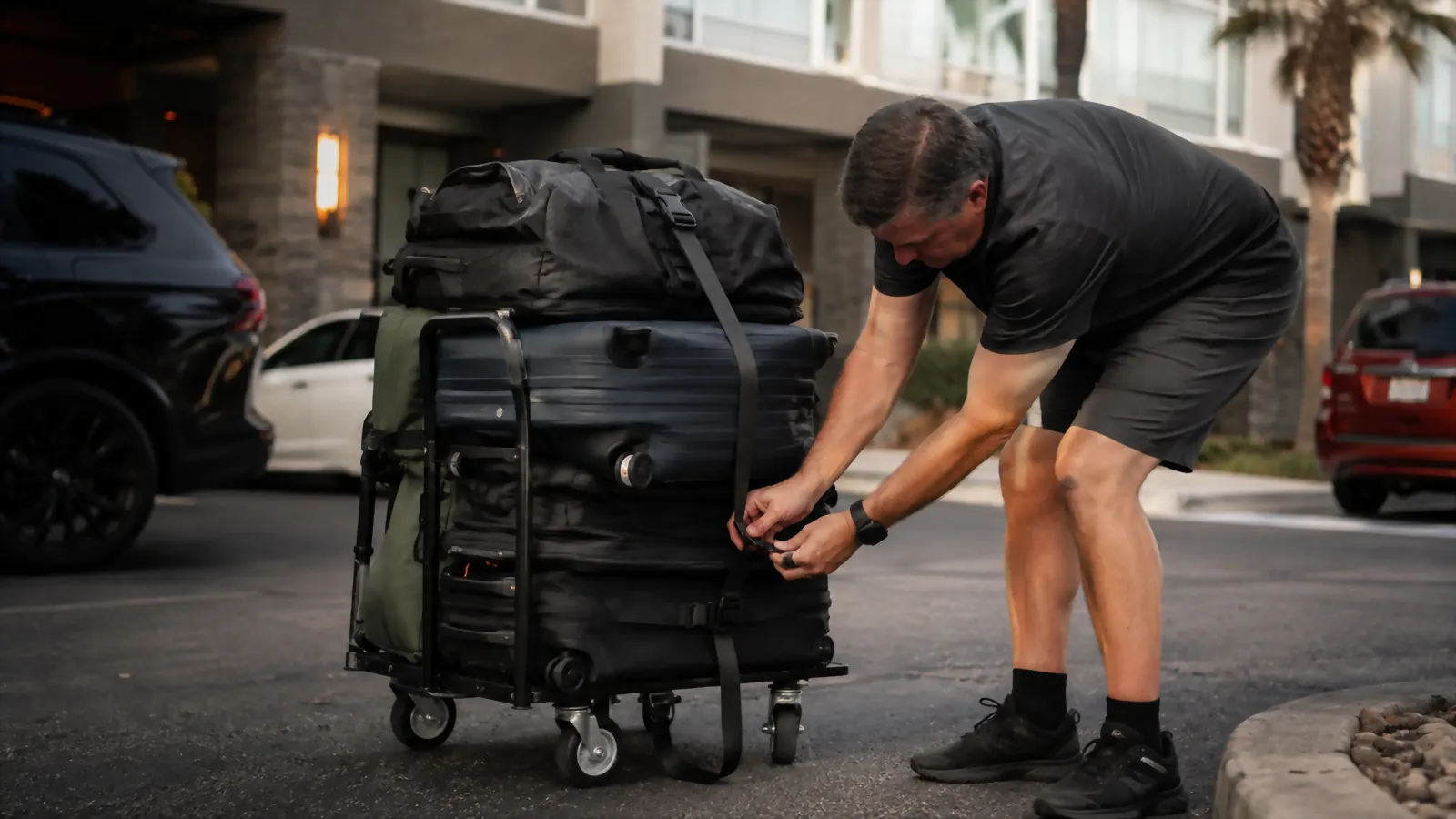
Every folding cart has some kind of strap, and skipping it is the single most common mistake I see people make. The load looks stable standing upright on its own legs, then the moment you tilt the cart back onto its wheels to roll, gravity shifts and anything not secured starts to slide.
Strap across the whole stack, not just around one bag. You want the load compressed together as one unit so it moves as one unit instead of shifting piece by piece. If the strap is loose enough to slip a hand under after cinching, it isn't tight enough yet.
Do this strapping step before you tilt the cart back, not after. Trying to strap a load that's already leaning is how bags slide off mid-strap, right into your shins, usually in front of a full row of people waiting for the same elevator.
Step 4: Test the Balance Point With a Short Push
Before committing to a long walk across a lot or a terminal, tilt the cart back to its rolling angle and push it a few feet on flat ground first. You're checking two things: does it roll straight without pulling to one side, and does the load stay put when you stop short.
If it pulls left or right, the weight isn't centered and needs to be rebalanced before you go any further. If anything shifts when you stop, the strap needs another turn. A short test now saves you from finding out the hard way in a crowded terminal or on a sloped driveway with your hands full.
This is also the moment to check your own grip and stance. Hold the handle at a height where your arm stays slightly bent, not locked straight, and keep the cart close to your body rather than pushed out ahead of you. Rolling a heavy load close in gives you far more control than steering it from arm's length.
Step 5: Plan the Route Before You Roll, Curbs, Gravel, and Elevators
A loaded cart behaves differently depending on the surface. Smooth pavement and tile floors are easy. Curbs, gravel, and elevator gaps are where a heavy load gets away from people who otherwise did everything right.
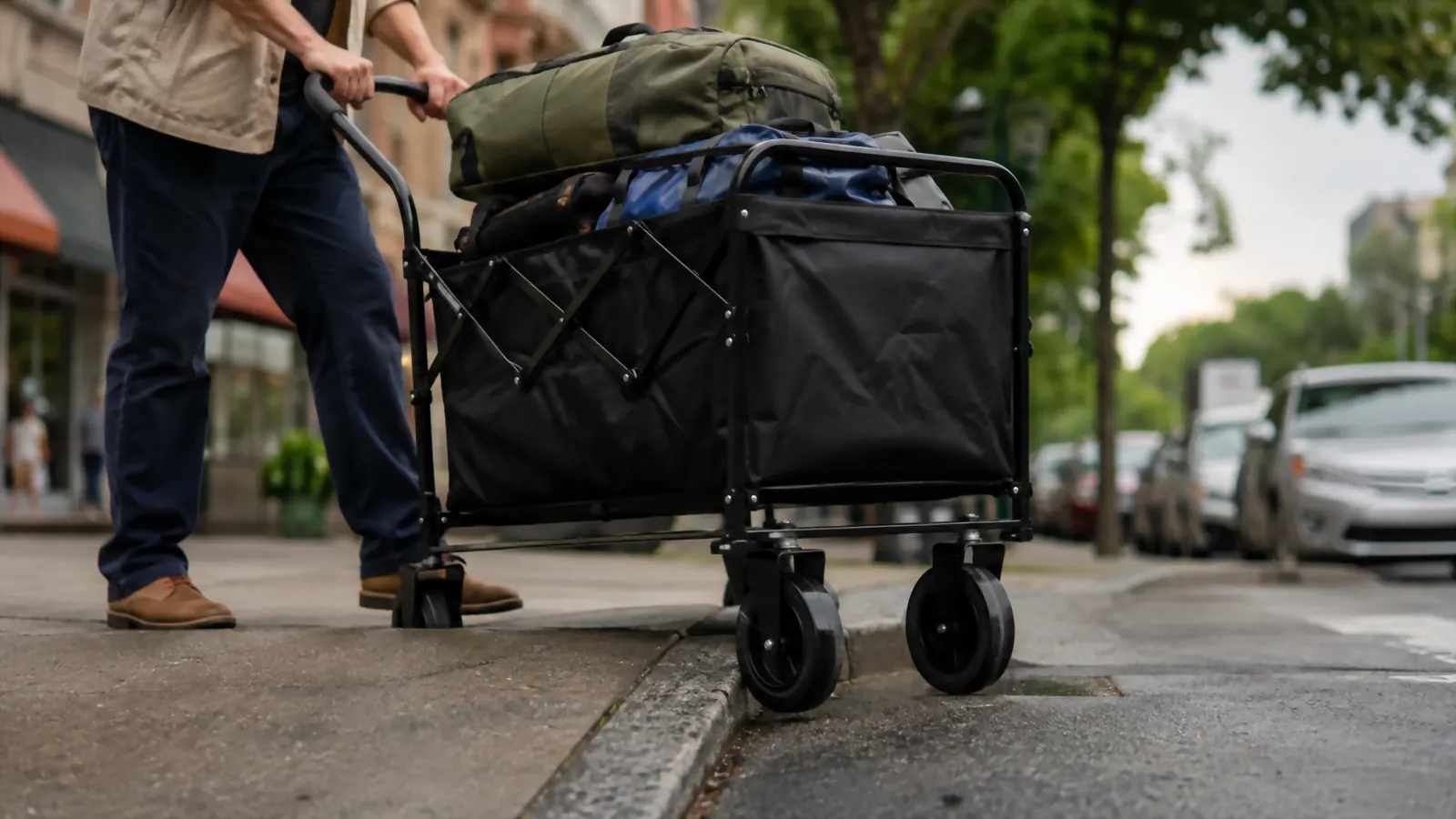
For curbs, approach at a slight angle rather than straight on, and take the front wheels up first, then follow through with a steady push rather than a shove. For gravel or uneven ground, slow down and expect more resistance. Wheels dig in on soft surfaces, and a load that rolled easily on tile will fight you the moment it hits loose stone.
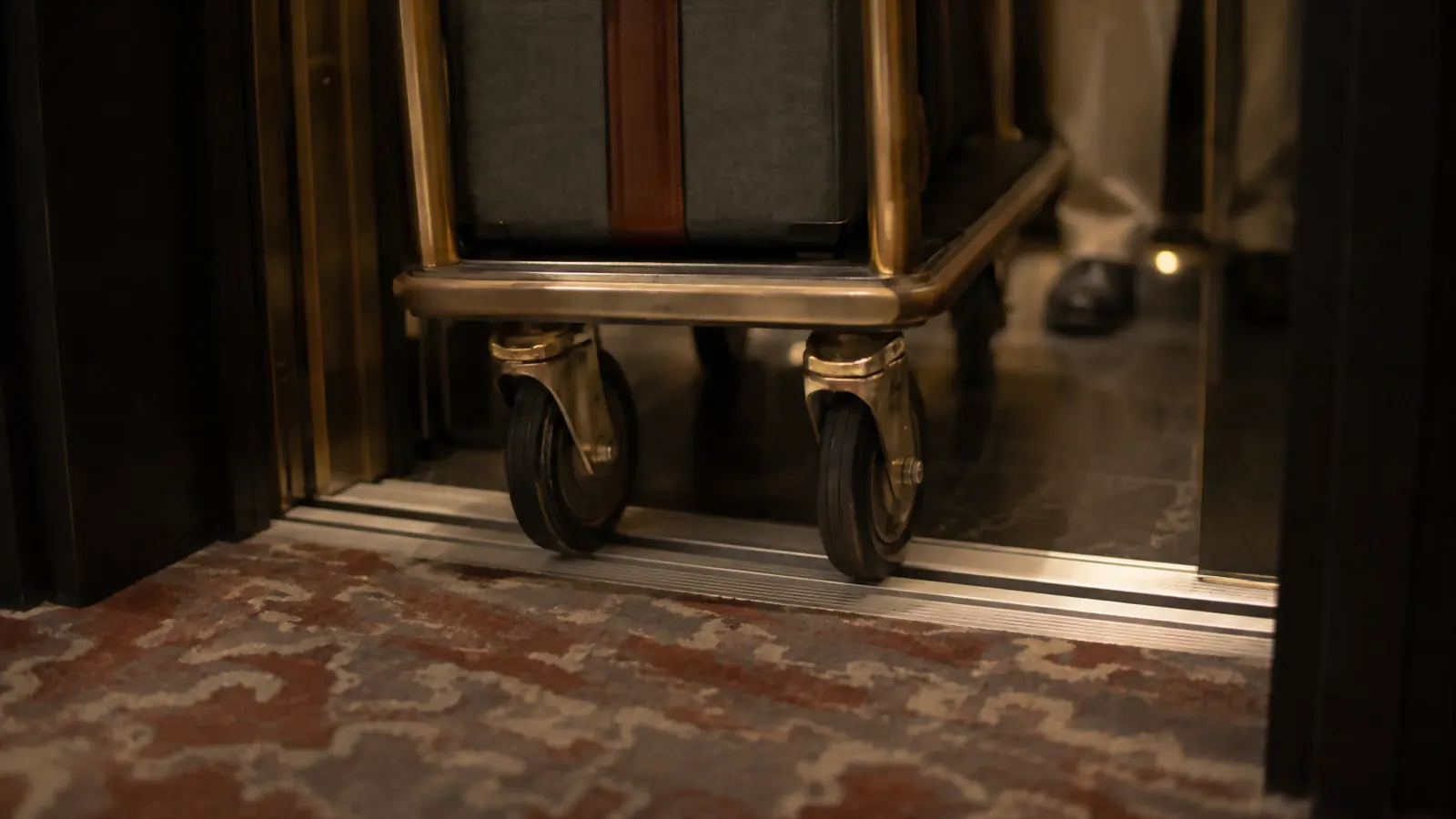
For elevators, line the cart up so the wheels cross the door gap at a right angle, not diagonally, and keep a hand on the load until you're fully inside. It's a small thing, but it's where I've seen more near misses than anywhere else: someone rolling in at an angle and catching a wheel right in the gap.
Common Mistakes That Undo These Steps
The first is loading past what the cart is built for and hoping it holds. A cart under real strain doesn't always fail loudly, sometimes it just gets harder to steer, and by the time you notice, you're already fighting it across a busy lot with no easy place to stop and restack.
The second is treating the strap as optional for short distances. A ten-foot roll from the trunk to the front door feels low stakes, right up until the cart catches a crack in the driveway and the top bag lands on your foot. Short distances are exactly where people skip the step that matters most, because the trip feels too short to bother.
The third is switching surfaces without adjusting your pace. Rolling confidently off smooth tile straight onto gravel or a grass verge, at the same speed, is how a controlled push turns into a scramble to keep the cart upright. Slow down before the surface changes, not after you feel it change under the wheels.
A cart doesn't replace the work, it changes where the work happens, from your back to your arms, and from a single lift to a controlled push.
What Else Helps
Beyond the five steps, a few habits make repeated use easier. Fold the cart down flat between uses so it isn't taking up trunk or closet space when you don't need it. Check the strap for wear now and then, since it takes the brunt of the tension on every heavy trip. And think about the surfaces you cross most: if your routine is mostly curbs and short pushes, that's a different demand than long straight corridors and open lots.
The SPACEKEEPER folds down for exactly this kind of in-and-out use, which is part of why it's the one that stays in my trunk instead of a closet at home. A cart you have to dig out of storage is a cart you'll eventually stop bothering with, and then you're back to carrying heavy luggage the hard way, one bag at a time, arm dropping lower with every parking row you cross.
It's also worth building the five steps into muscle memory rather than treating them as a checklist you reread every trip. After enough repeat trips, matching the load to the cart, stacking heaviest first, strapping before the tilt, testing the balance, and reading the surface ahead becomes automatic, the same way checking your boarding pass or patting your pocket for your wallet becomes automatic. That's really the goal: not a perfect method you follow once, but a habit that holds up on a rushed morning when you're carrying more than you planned for.
Load It Right and the Cart Does the Rest
Five steps, done in order, turn a folding cart from a strapped-on afterthought into the thing that actually moves your heavy luggage for you. The SPACEKEEPER folding hand truck is rated for up to 500 lb and holds a 4.0 rating from 9,304 reviews. Check today's price and see if it fits your routine.
Amazon Check Today's Price on Amazon →